I mentioned before some of my favorite character designs in the world of comics and have been meaning to tackle this subject again. I came to realize, however, that “character design” is itself a fairly massive subject, and that it would be best to break the topic down into separate installments. Today, true believers, we’re going to talk about outfits and costumes, which are often a pivotal part of a character’s design.
3 Essential Questions
Clothing can convey quite a bit of conscious and unconscious information to the reader, but it should never be doing 100% of the legwork. Body language, shape and overall behavior all come into play when building a character, and the trick is to figure out what clothing can do that these other elements can’t. To get started, it’s important to ask some basic questions about your character before jumping into costume design.
1) Costume Hierarchy
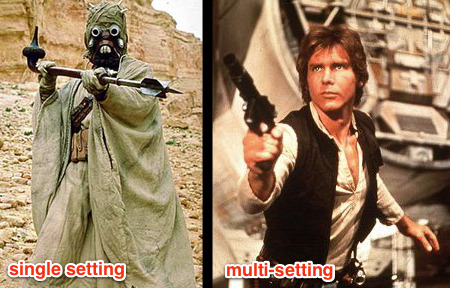
How often does this character appear? Is it a main character or a side one? Primary characters have more complex needs than side characters, which is to say that the more information you have about your character, the more that can be conveyed in their appearance. Additionally, the more frequent the character appears, the more versatile the design needs to be.
2) Environmental Relationship
If it’s a side character that only ever appears in one setting, for example, you need only design the outfit to fit in that environment. If they are a main character, though, chances are you’ll need the outfit to mesh with more than one setting.
3) The Naked Test
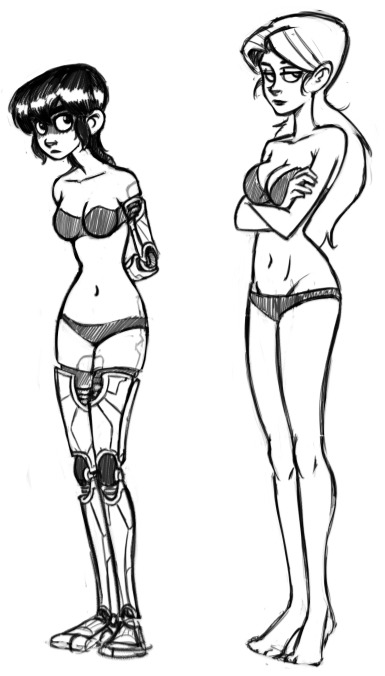
Is your character recognizable without any clothes on? Body types, especially those of the main cast, should be distinctive even without the help of any outfits. The naked form is the foundation of all character design. Before you start dressing your body, make sure it’s a body worth dressing.
Once you’ve sufficiently answered these questions, it’s time to jump into the actual design phase!
Shape
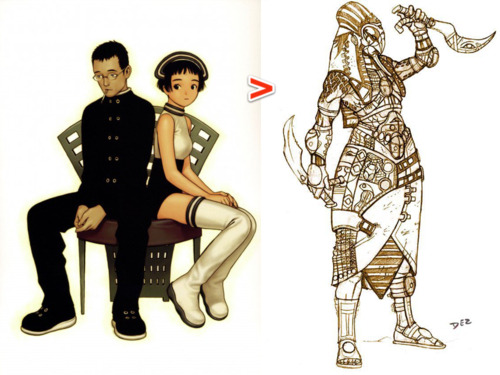
Every character, no matter how complex, should be designed around an overal unique visual shape. This theme should not repeat in any other character. This shape should be readable enough that if you were to shrink all your characters into a super-simplified cartoony state, they should still be distinguishable. Character designs follow a hierarchy: you grab the reader’s attention with the most essential information and then invite them to investigate the details. If important elements of your design are only evident in the details, then it needs to be reworked. If your character is not completely distinguishable in silhouette, it needs to be reworked. Detail should always radiate from the core theme.
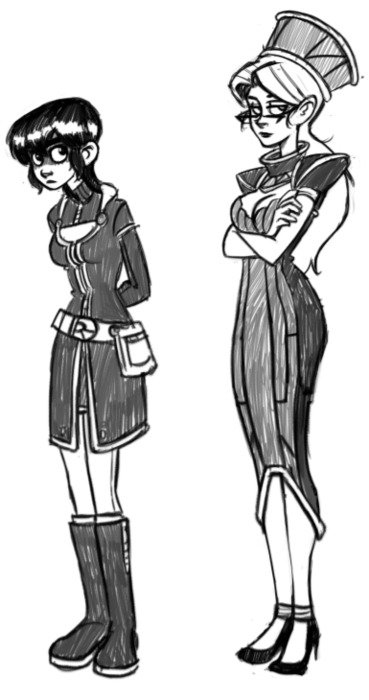
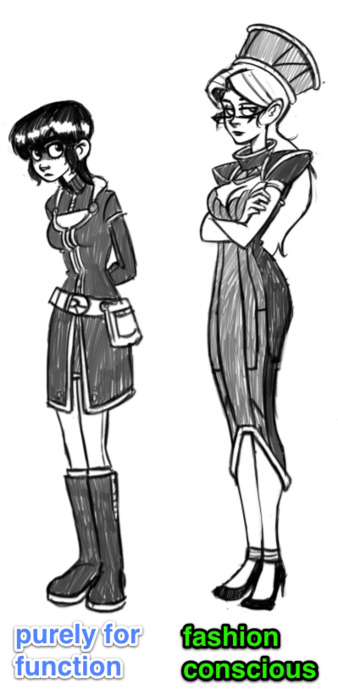
Kim and Vonnie stay distinct in a few ways.
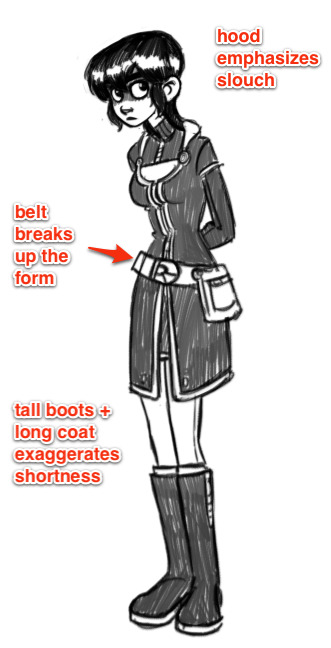
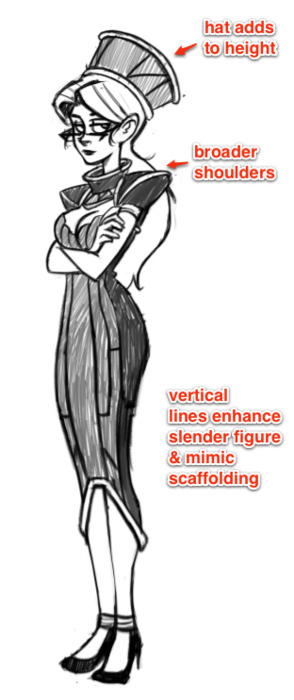
The primary difference in shape between the above two characters is one of curves versus triangles. Vonnie is very angular, and her clothing’s angles mimic the scaffolding of an art deco building to emphasize her height and posture. Kim’s outfit makes her look shorter, but jaunty. There are a lot of soft curves going on there to make her seem younger and more innocent.
Action
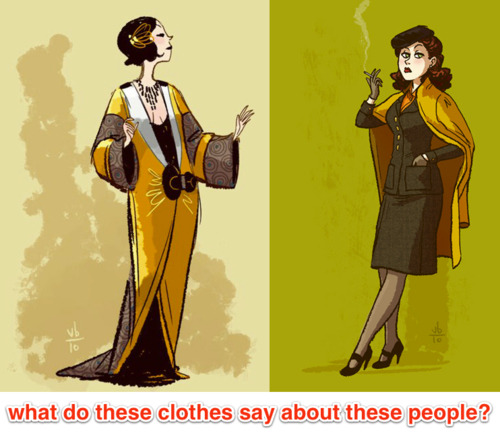
What does your character do? In what way would their clothing reasonably convey how they spend their time? This is an easy question if it’s a uniformed occupation, but it certainly doesn’t stop there. A more bookish or socially inept character is often prone to mismatched clothing, while a person of a very high social status is often wearing clothing that is physically less practical than those of the working class.
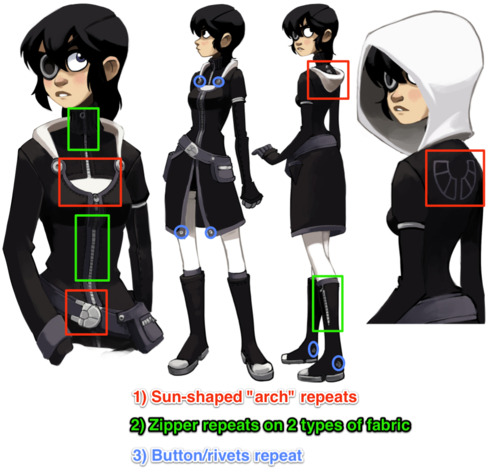
How does your character move? What are their default postures and body language? A good outfit should accentuate the body movements that you deem most important. If a character stoops and hunches a lot, their clothes can augment that behavior. For example, Kim is frequently hunched over, so I tend to dress her with a hood that’s shaped to go with poor posture, as well as a repeating “arch” shape to suggest this basic form.
Communication
How much does the character wish to communicate with their clothing? Not everyone wears their personality on their sleeve, nor is everyone especially fashion-conscious. Nothing’s worse than having a cast where everyone is immaculately dressed and overdesigned. A more outgoing character might be more aware of their appearance, while a more introverted one may be less concerned. To add another layer, a character may dress a certain way to disguise something they don’t want to show to others, just as someone might act overconfidently to hide their insecurities. You can tell your audience a lot about your character through what that character chooses to display to others.
Repetition
Core shapes and patterns should repeat on the outfit. The entire design should exhibit some bilateral cohesion, which is to say if you were to cut the character in half horizontally or vertically, each part should look like it belongs to the other.
As mentioned, Kim has a lot of solid colors and arch shapes which are broken up by fabric and metal seams, with very few sharp edges.
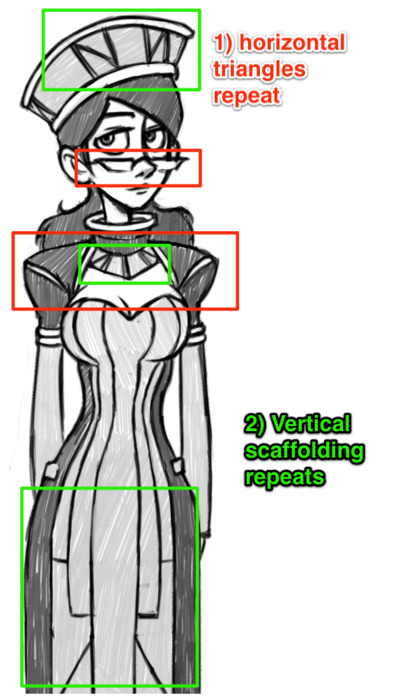
Vonnie, on the other hand, is structured almost like a building, with vertical lines and triangles that take the shape of supporting beams on the surface of her outfit. Her triangles and broad horizontal planes repeat throughout her outfit, including her glasses.
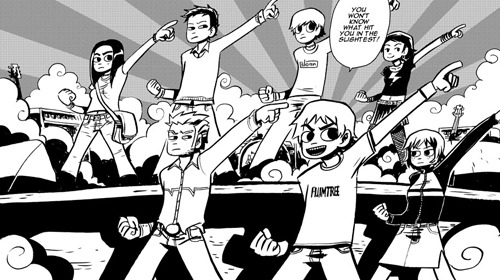
This extends to multiple costumes worn by the same character. Even if a particular character changes clothes, the core shapes should still be evident. Scott Pilgrim is a good example of this. Most of the cast change clothes frequently, but in each scene it’s generally easy to recognize the characters by the “type” of clothing they choose. The details change, but the essential shapes do not.
Color and Contrast
Different colors can imply different moods. ”Winter” colors like cooler blues and purples can suggest an introspective or reserved personality, while warmer colors like yellow or red can imply a more energetic attitude. If your character only ever interacts in one type of setting, you only have to worry about how those colors will fit in one environmental color palette. If, however, your character needs to mesh well with more than one environment (as is usually the case with protagonists), you have to make sure your character’s colors will fit with multiple settings.
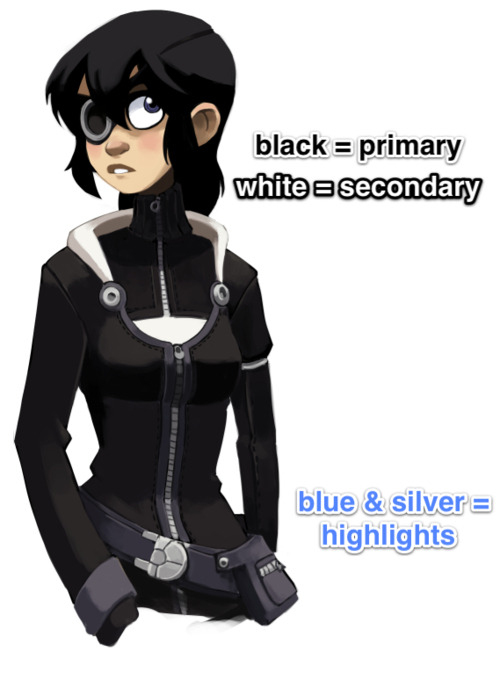
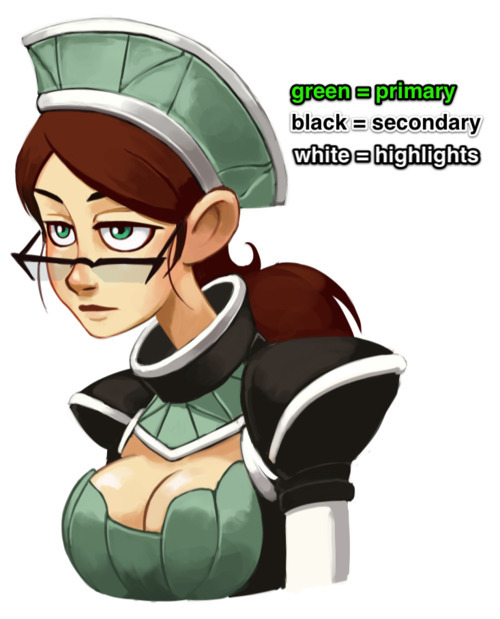
Also, don’t be fooled by superhero comics: it’s generally bad form to have two dominant colors in a single costume. My personal rule of thumb is to have no more than one prime color in an outfit design, followed by a secondary and then supporting colors.
In the case of Kim’s outfit in Dark Science, the primary color is black, with the secondary being off-white. These are then supported by the muted blue and silver accents that appear in both her prosthetics and clothing. Color and value contrast is very important, especially for a main character, which is why Kim’s basic palette can be reduced to black and white without losing any essential information.
Vonnie’s outfit is more colorful, but less contrasted as a whole. Green dominates and is blocked in by a secondary, warmer black. Green is the complementary color of red, and so her clothes naturally bring attention to her hair and reddish skin tone, inherently highlighting more sexual elements than Kim (whose black outfit essentially matches her hair). White is also present, but it’s only a supporting color here.
Simplicity
Above all else, keep it simple. Comic characters are not pin-ups or other illustrations; you have to draw them over and over again, from various angles. If you pile on too much detail, you’ll wear yourself out slogging through all the bits every time you have to draw them.
If you follow all these rules, good costume design should create this basic pattern when presented to a reader:
- Read: Silhouettes and essential shapes should be instantly recognizable
- Inform: The costume should then tell the reader essential things about the character
- Compel: The costume should then invite the reader to learn more about the character
- Move: The costume should never impede the flow of action within the comic
If you stick to these basic guidelines, you’ll never fail. Next up on character design: bodies and faces!
Author: Alex Heberling
Alex Heberling here. I own the place.
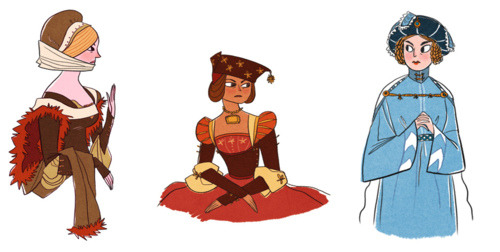
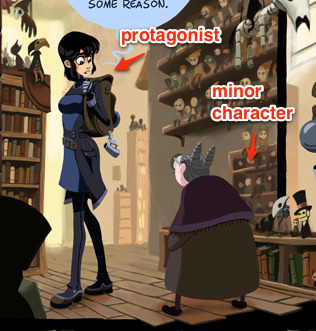
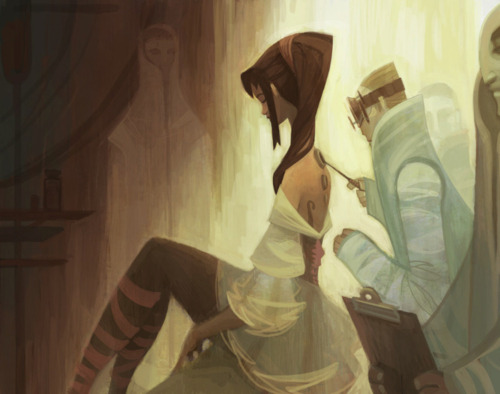



Silhouettes: the Silent Killer
The eye isn’t a camera. When we view objects, especially moving objects, our brains tend to break them down not into a collection of varying hues, but rather silhouettes. Quick object identification is a primal evolutionary necessity, and it’s a foundational way our visual interpretation works. It’s why camouflage works too.
When an object’s silhouette is difficult to make out, we have a tough time keeping track of what we’re seeing. It’s why so many comics and drawings use the visual shorthand out outlining figures and objects. The shades and values of an object are secondary to the basic shape when it comes to recognition. As such, effectively managing silhouettes is a vital tool for visual narratives.
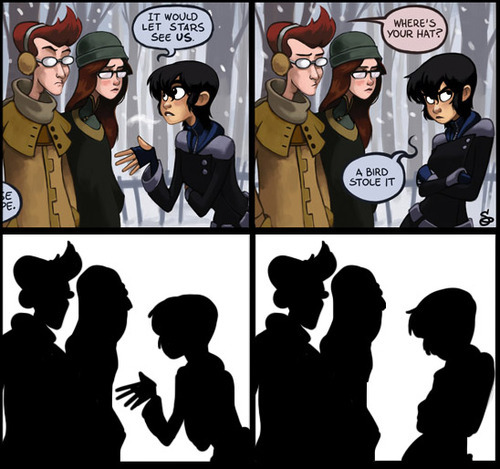
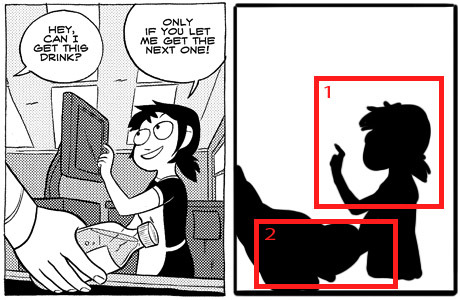
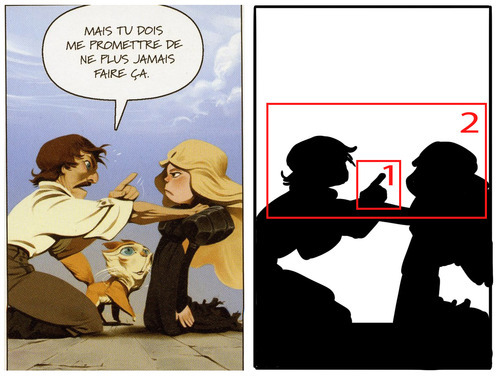
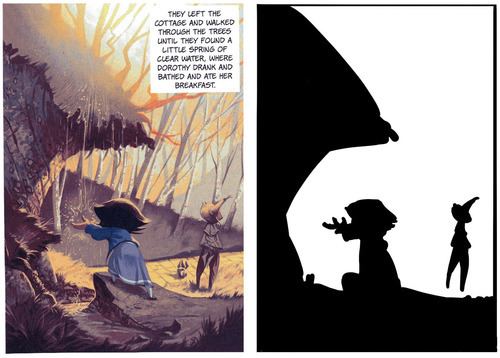
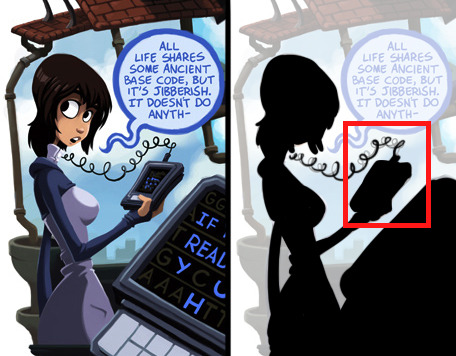
Essentially, the general rule is if you were to fill in your characters and objects with black, you should still be able to tell what they’re doing. All the most essential elements need to be far enough away from the “body” or primary silhouette so that they are distinguishable. The less important elements don’t need to be isolated this way. In the above image, the only two significant things we need to know is that 1) Kim is talking with Ron and Vonnie, and 2) that she is gesturing in an explanatory way and then retreating her gesture. Simple as that.
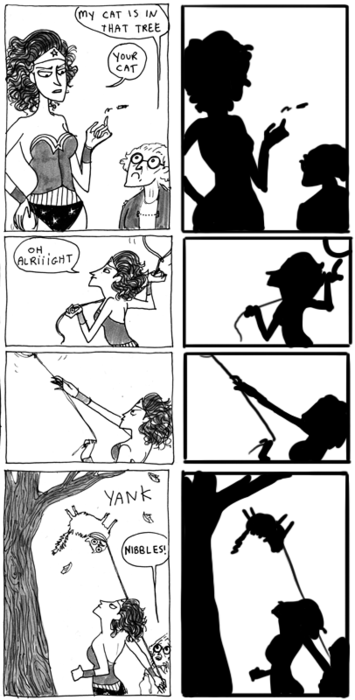
Readable gestures can make or break a scene. Compare Kate Beaton’s clear posing with Wonder Woman in these panels:
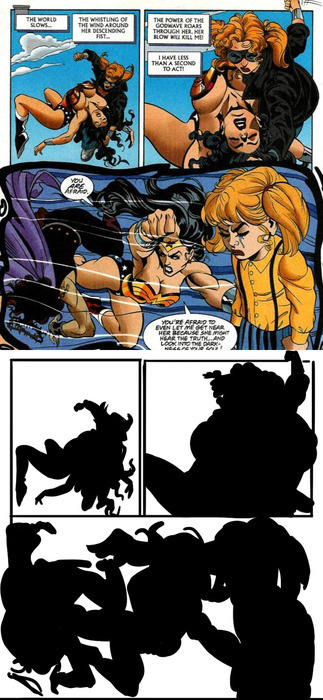
To this decidedly less readable Wonder Woman page:
If what’s going on isn’t clear at the fundamental level, the details can’t save it. This isn’t, of course, to say that you can’t have a complex image that’s also readable. It just requires a lot more skill and attention:
All the essential elements are here above. The lines of action, the relevant silhouette intersections and the overall clarity of what’s happening.
As I’ve mentioned before, when blocking out a scene, it’s useful to identify a hierarchy of visual importance. In general, an isolated silhouette element has a higher visual importance than one that’s intersected with something else. By keeping the essentials clearly defined in silhouette and less important elements intersected or obscured in silhouette, you’ll more easily maintain clarity and effectively draw the reader’s eye to what’s most relevant in a scene. (I should note that when I say “importance” I mean the order in which things are viewed, not necessarily what’s literally most important in a scene.)
While silhouettes alone don’t determine all the essential information of a scene, they are more often than not the foundation. If the most important elements can’t be readable in a simplified form, it means the foundation needs to be reworked. This applies not only to panels and scenes, but to the designs of the characters and environments themselves.
If you can’t easily distinguish your characters by silhouette alone, they should be reworked. Silhouette recognition is a vital part of design, so vital in fact that I’m going to save it for my next post about character and costume designs!

Drawing Hands: Augmenting an Idea
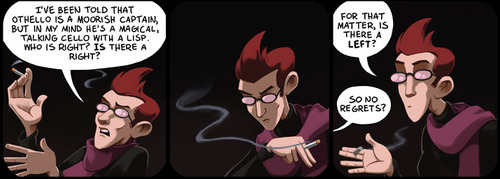
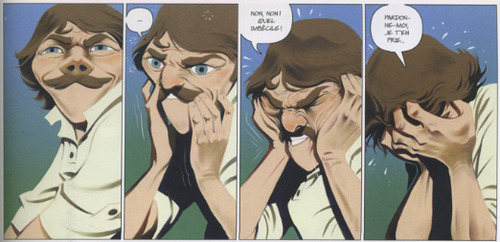
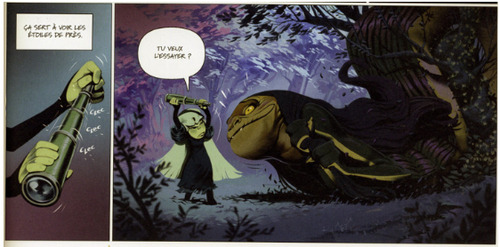
Most people understand the importance of facial expressions in cartooning, but if there’s anything that’s routinely neglected, it’s hands. It’s a shame too, since hands are the second thing we instinctively look at when a person is speaking to us. We use our hands in a variety of ways to accentuate our point; if we actively restrict ourselves from gesturing at all, natural speech actually become rather difficult. This goes beyond dialogue, too: hand gestures lead us to what’s important, and they’re the most frequent body part to indicate action and interaction with the environment, as well as other characters. Hands dominate the focus on what’s important in a scene, and to neglect this is to neglect a pivotal tool in storytelling.
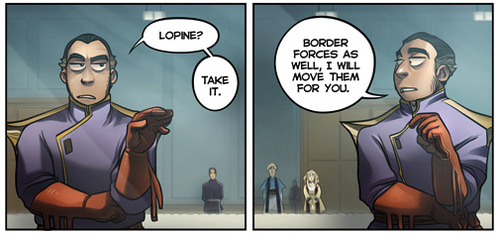
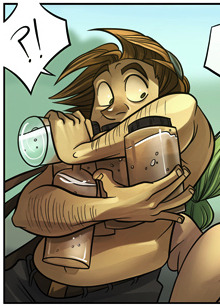
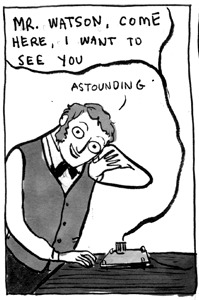
The Meek is an excellent example of a webcomic that knows how to use hands. They’re not just used to accentuate a gesture or mood, but different characters have different habits of gestures, just like real life people. Whether it’s a subtle gesture (indicating a sort of royal calm) like above, or an indication of surprise or bewilderment:
An innocent investigation:
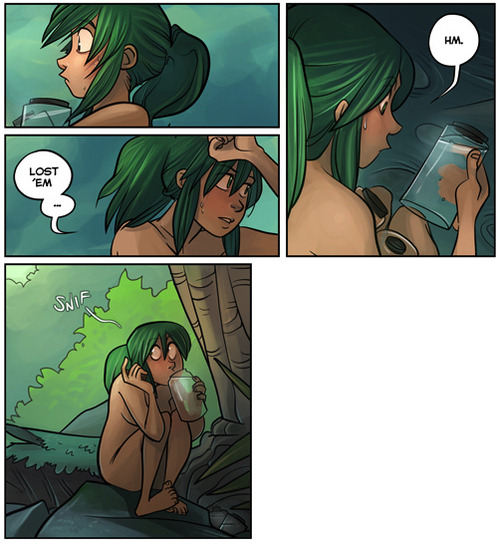
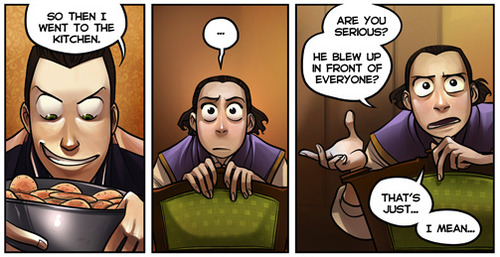
Or visible frustration:
In the above image, we go from the girl’s hands centered in the frame, almost mirrored. It keeps the focus dead center and the composition flat. Then the “camera” shifts to the left, bringing us out of that moment of mental processing and onto the action. Her right hand gestures outward, and we instinctively want to follow it to the next scene, whatever that may be.
Enrique Fernandez does an especially good job of hand interaction with other objects and faces. They allow us to focus on what’s most important in a scene. Guiding the eye is a central part of comic art, and hands are an efficient way to achieve this.
Despite being lavishly detailed, there’s never any confusion as to what the focal point is in each panel. If the reader has to try too hard to figure out what’s important, they lose interest in the visual path of the image and may lose interest in the comic altogether.
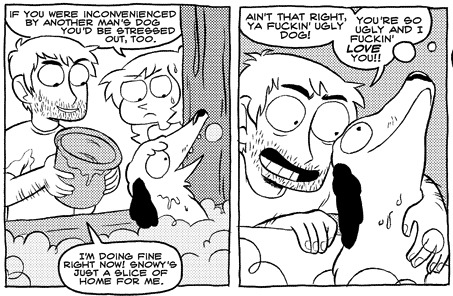
Hands need not be realistic or detailed to achieve their purpose. Octopus Pie is a very “cartoony” comic, but there’s an economy of movement and composition in every panel to get the main point across. Hands are not afraid to touch objects and gesture appropriately. There’s a definite language to the characters’ gestures as well, and no two characters use their hands the same way.
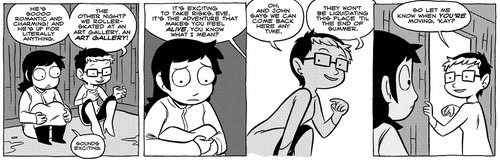
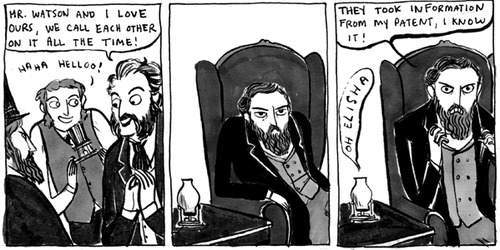
Hark, a Vagrant is an even more extreme example. There’s really very little realism to the forms in general, especially the hands, but still they are extremely expressive and clearly readable. There’s never any confusion as to how a character is behaving or feeling.
In short, hands are a big thing we look for when engaging a person. Regardless of style, if an artist wants to have relatable or engaging characters, those characters have to move and act like people, and those people need to be gesturing in a way that moves the action forward clearly and effectively.

Primary & Secondary: a Tale of Two Focal Points
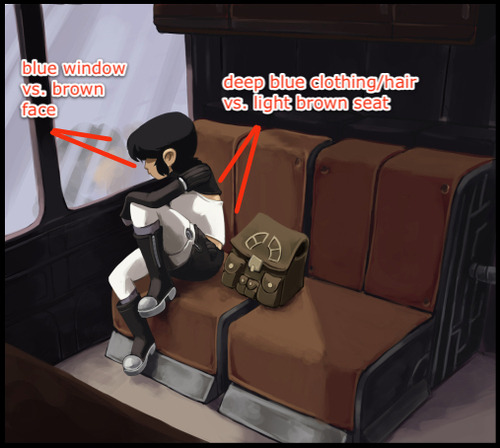
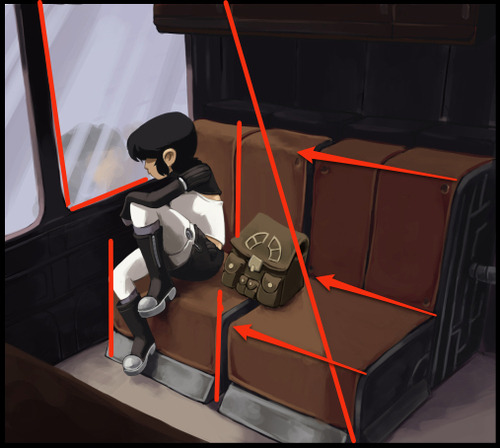
In painting and general illustration, there are some basics everyone should know about composition. Chief amongst these is the importance of a focal point. A focal point is the primary focus of a picture, whether it’s a person, object or simply an abstract portion of the image. Humans have binocular, mammalian vision and our action of “looking” instinctively relies on focusing, not just seeing. Unless we’re looking at a magic eye 3D image, our eyes are only really comfortable with an image that has a clear focal point. Once that’s clear, we allow our eyes to wander and take in the other details.
Achieving a solid focal point isn’t terribly difficult. A few tools that will help are contrast (overall the most indispensable):
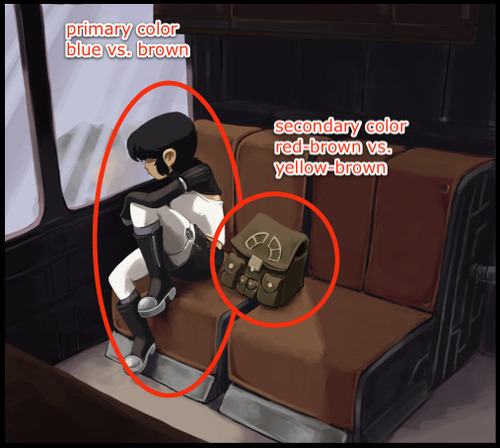
Complementary Colors (a subset of contrast):
And overall structure:
However, these are the conventions of painting and illustration, which have somewhat different goals from comics. Comics, even in a single panel, employ the art of the visual narrative, which means there are unique demands for guiding the reader’s eye. Having a single focal point can be enough for some panels or images, but oftentimes it’s necessary for comics to employ multiple focal points in a single image to not only draw the eye in a meaningful, sequential fashion but also to heighten the reader’s excitement and immersion in the story.
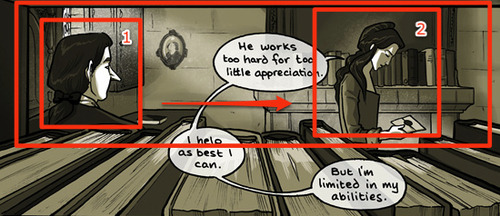
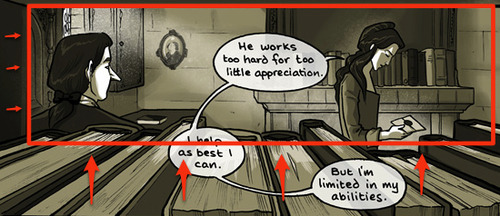
“Sequential art” doesn’t just refer to a sequence of panels, individual images also lead the eye in a sequential manner. There is a hierarchy of focal points that guide the reader through the visual narrative. In the above panel from Family Man, we see the above “focal point” tools being used to create a nice frame, but from there the composition is divided further, first focusing on the man, and then to the woman. A clear hierarchy within the visual sequence is established with some more advanced techniques.
Gazes moving from left to right:
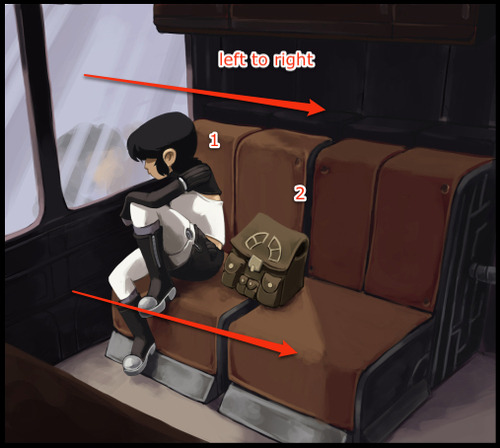
In Western comics, panels and text are read from left to right, so it’s in the best interest of the artist to take advantage of this natural habit of the reader’s eye. Unless forced to do otherwise, the reader is going to look at the top left corner of a comic image and move to the right. A reader will also instinctively look in the direction a character is looking, and in this panel the artist is taking advantage of both of these habits. We start on the man, who is looking at the woman, upon whom we then focus.
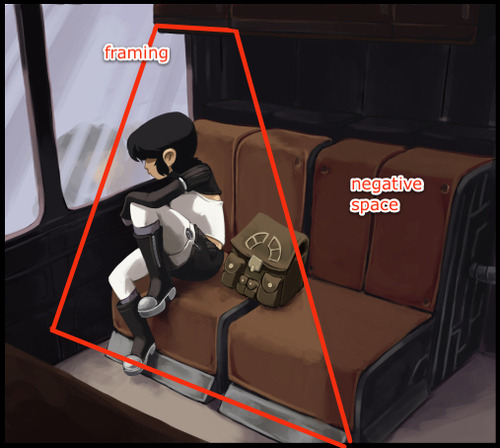
Framing:
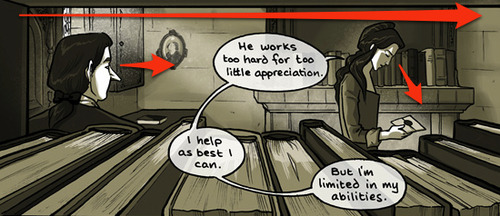
There’s a frame created by the books and bookshelf that keeps the eye from drifting downward. This reinforces the previous technique of moving the eye from left to right. (Notice too the slight dip in books near the woman’s hand, drawing the eye to a third and softer focal point, ie: the letter).
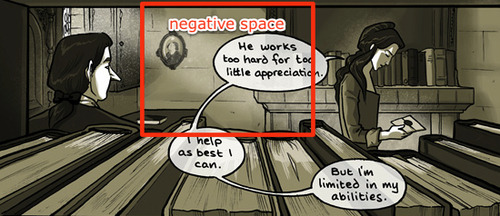
Soft division through negative space:
What largely separates the two focal points is a low detail negative space, where the contrast is low and the eye doesn’t linger. It also creates a 3D triangle of sorts: if we were shooting lasers out of our eyes, they would start at the man, ricochet off the wall and hit the woman.
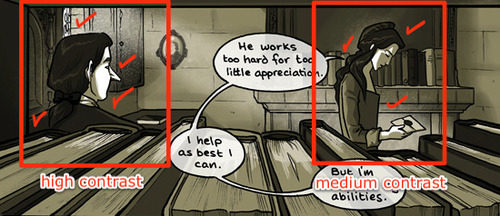
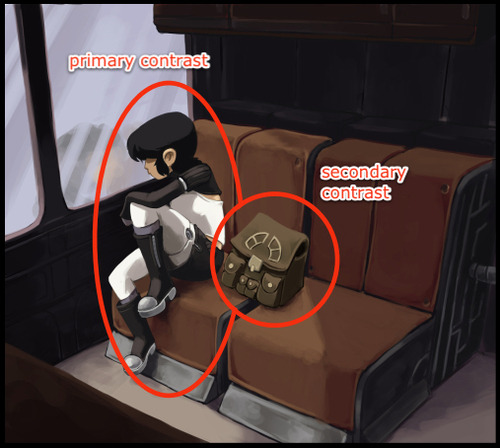
Primary and secondary contrast levels:
It’s subtle, but the values surrounding the man are more contrasted than the woman. This largely serves to reinforce the tools previously mentioned.
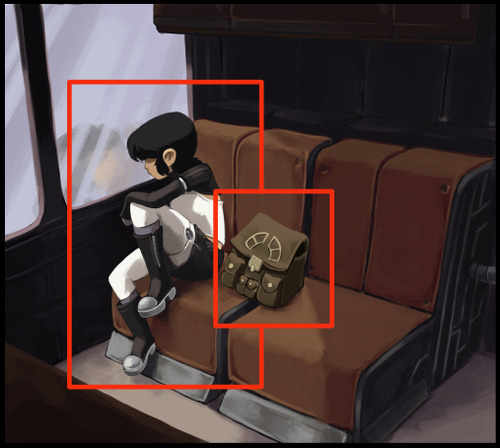
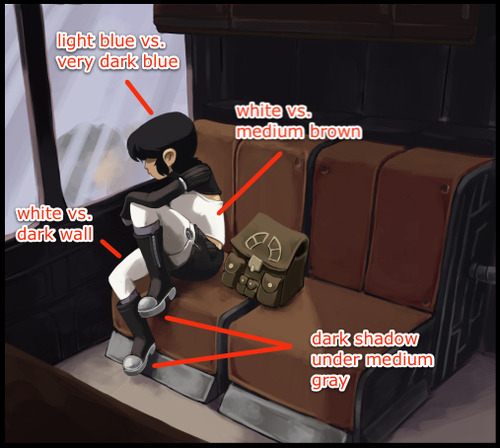
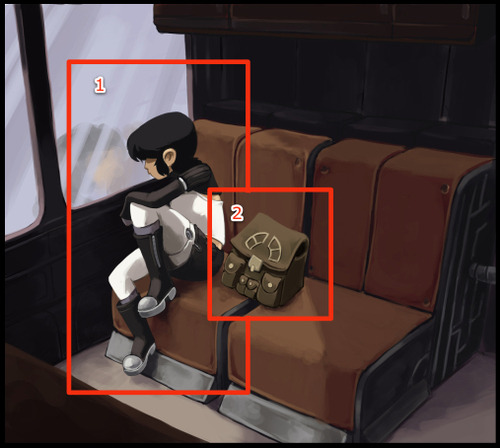
These types of techniques are also prevalent in the first image I showed, with Kimiko being the primary focus and her bag the secondary focus:
As you can see, the tools needed are slightly different, partially because of the larger colors used and other compositional requirements (for example, the image with Kimiko has a more complicated frame because it uses a 3-point perspective instead of 1). The point to take home is that there’s no one way to make this work; you may use some of these tools and not others, depending on what the image requires. Additionally, it should be noted we’re not limited to two focal points. Depending on the comic, there could be more. It all depends on what the visual narrative requires.
This is the key: no matter what the style, comics are a visual narrative. If we establish a clear sequence of visual relevance, the reader’s eye is active and their mind is engaged. Pull them into your world and keep them for a while.
Environments are People Too
There’s a wide variety of approaches when it comes to environment designs in the comic medium, and although there are certain key elements that divide comics from motion media, it’s somewhat useful (in the case of environments) to place comics in two basic camps: film vs. sitcom.
Modern newspaper strips, especially the gag-driven variety, employ environment conventions similar to that of sitcoms. Sitcoms trace their origins to stage and radio performances, where the focus is very much dialogue driven. Most of the physical action is exclusively between the characters, and it’s very rare for the actors to turn their back to the audience (partially because their voices need to project in the direction of the viewer). As such, the “sitcom” variety of comic strip often employs minimal visuals when it comes to environment, as the primary goal is to deliver a verbal punchline. There are some excellent examples of this style of comic strip, though I personally feel this approach is overrepresented in American comics, especially the web variety, and it’s often employed for comic styles that don’t benefit from this minimalism.
There’s another breed of comic, however, that parallels more closely with film. Because of the nature of the medium, film is inherently (though not exclusively) more location-driven than the stage, and comics of this style in turn rely on a stronger connection between the characters and their environment. Comics are about efficiently conveying concepts and moods, and this style demands an intimate connection between reader and the world being presented by the cartoonist.
In the above page by Enrique Fernández, a significant amount of information about both the character and his environment is being conveyed. Aside from the more obvious elements like the character’s personality being conveyed through body language, there’s a lot the environment is implying. The top panel introduces a distant vanishing point behind the man, giving the impression that he’s traveled far to reach this point. The low angle of panel #2 emphasizes the height of the action as well as the potential distance (and danger) of the fall. The dark shadows and narrow spaces of panel #3 indicate a change of mood from freedom to impending danger/detection (the narrow band of “light” space cutting through the panel and the character’s silhouette is especially powerful). The final panel emphasizes that the man does not want to be seen; the wall seems to be pushing back against him, trying to shove him out of frame. We want to know what he’s looking at; we were set up with the previous panels with a sense of motion, and now though he seems to be frozen, the environment now has become the primary actor. We’re drawn in without a word of dialogue.
Fernández is also good at establishing an environment as a character unto itself.
As is the case with the above page, oftentimes a story requires that the setting be much more than a place upon which the plot unfolds, but an active participant in the antagonism or encouragement of the characters. In the end, regardless of the specific purpose, it should always be about engaging the reader, inviting them into the world you built and keeping them interested in the unraveling of the narrative.
Superhero comics, oddly enough, should benefit from this greatly but it’s rare to see it effectively employed. There tends to be an immense focus on the design and posing of the characters with very little attention paid to how those characters are interacting with the environment. Ironically, western superhero books seem to take their cues from the sitcom school, where more often than not the characters seem to be posing for a photograph that no one’s taking.
Obviously I’m not dismissing all superhero comics, but it is a dominating trend in the most popular styles. There are, however, some powerful exceptions, like the masterful Frank Quitely:
The important point here is that it’s essential to decide what tools work best for the comic at hand. Mismatching approaches is an easy mistake to make, but it can carry extensive consequences.




Untitled
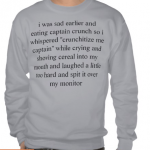
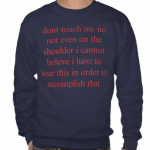
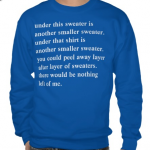
I’m… not sure what I’m looking at.
But I’m kind of into it.
Untitled
Let’s Draw The Hues! Page 19 Flats [2 of 4]
(Source: https://www.youtube.com/)
Untitled
So? SO?
Reblog for the day/evening crew, since I posted a bunch today and it got a little lost. ^__^
Isso prettyyyyy!
Untitled
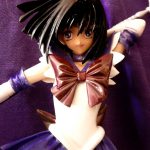
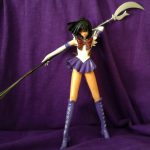
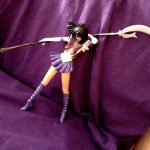



SAILOR SATURN
100% hand painted by myself.
the crystal to put on her lace is broken :(
Looks great! One of these days, I’m going to get myself one of these garage kits to put together. :D