
Tag: reblog
Untitled

Hot-Fire Tests Show 3-D Printed Rocket Parts Rival Traditionally Manufactured Parts
What can survive blazing temperatures of almost 6,000 degrees Fahrenheit without melting? What did not break apart at extreme pressures? What is made by a new process that forms a complex part in just one piece? What takes less than three weeks to go from manufacturing to testing? What can reduce the costs of expensive rocket parts by 60 percent or more?
Answer: 3-D printed parts
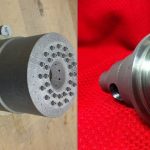
Image (above): 3-D printed rocket injector as it looked immediately after it was removed from the selected laser melting printer (left). Injector after inspection and polishing (right). Credit: NASA/MSFC
Engineers know that 3-D printed rocket parts have the potential to save NASA and industry money and to open up new affordable design possibilities for rockets and spacecraft. But until recently, no one had tested rocket parts critical to engine combustion in a hot-fire environment.
NASA engineers at the Marshall Space Flight Center in Huntsville, Ala., not only put rocket engine parts to the test but also were able to compare their performance to parts made the old-fashioned way with welds and multiple parts during planned subscale acoustic tests for the Space Launch System (SLS) heavy-lift rocket. In little more than a month, Marshall engineers built two subscale injectors with a specialized 3-D printing machine and completed 11 mainstage hot-fire tests, accumulating 46 seconds of total firing time at temperatures nearing 6,000 degrees Fahrenheit while burning liquid oxygen and gaseous hydrogen.
“We saw no difference in performance of the 3-D printed injectors compared to the traditionally manufactured injectors,” said Sandra Elam Greene, the propulsion engineer who oversaw the tests and inspected the components afterward. “Two separate 3-D printed injectors operated beautifully during all hot-fire tests.”
Post-test inspections showed the injectors remained in such excellent condition and performed so well the team will continue to put them directly in the line of fire. In addition to the SLS acoustic tests, Greene and her team tested a more complex assembly of a 3-D printed injector and thrust chamber liner made by Directed Manufacturing, Inc., of Austin, Texas. Marshall engineers transferred a second 3-D printed injector to NASA’s Stennis Space Center in Mississippi, where it will continue to accumulate hot-fire time to test its durability.
“Rocket engines are complex, with hundreds of individual components that many suppliers typically build and assemble, so testing an engine component built with a new process helps verify that it might be an affordable way to make future rockets,” said Chris Singer, director of the Marshall Center’s Engineering Directorate. “The additive manufacturing process has the potential to reduce the time and cost associated with making complex parts by an order of magnitude.”
Traditional subscale rocket injectors for early SLS acoustic tests took six months to fabricate, had four parts, five welds and detailed machining and cost more than $10,000 each. Marshall materials engineers built the same injector in one piece by sintering Inconel steel powder with a state-of-the-art 3-D printer. After minimal machining and inspection with computer scanning, it took just three weeks for the part to reach the test stand and cost less than $5,000 to manufacture.
“It took about 40 hours from start to finish to make each injector using a 3-D printing process called selective laser melting, and another couple of weeks to polish and inspect the parts,” explained Ken Cooper, a Marshall materials engineer whose team made the part. “This allowed the propulsion engineers to take advantage of an existing SLS test series to examine how 3-D printed parts performed compared to traditional parts with a similar design.”
View video of additive manufacturing inside Marshall’s 3-D printer.
Since additive manufacturing machines have has become more affordable, varied, and sophisticated, this materials process now offers many possibilities for making every phase of NASA missions more affordable. The SLS injector tests are just one example of NASA’s efforts to fabricate and test 3-D printed parts in relevant environments similar to those experienced during NASA missions. The SLS injector test series complements a series of liquid oxygen and gaseous hydrogen rocket assembly firings at NASA’s Glenn Research Center in Cleveland, which hot-fire tested an additively manufactured, select laser melted injector developed through collaboration of industry and government agencies. A J-2X engine exhaust port cover made at the Marshall Center became the first 3-D printed part tested during a full-scale engine hot-fire test at NASA’s Stennis Center. Marshall materials engineers are currently making a baffle critical for pogo vibration mitigation; it will be tested at Marshall and Stennis and is a potential candidate for the first SLS mission in 2017. Marshall engineers are finishing up ground tests with Made in Space, a Moffett Field, California company working with NASA to develop and test a 3-D printer that will build tools on the International Space Station next year. NASA’s Johnson Space Center in Houston is even exploring printing food in space.
Watch: Video of the test firing
“At NASA, we recognize ground-based and in-space additive manufacturing offer the potential for new mission opportunities, whether printing rocket parts, tools or entire spacecraft,” Singer said. “Additive manufacturing will improve affordability from design and development to flight and operations, enabling every aspect of sustainable long-term human space exploration.”
NASA is a leading partner in the National Network for Manufacturing Innovation and the Advanced Manufacturing Initiative, which explores using additive manufacturing and other advanced materials processes to reduce the cost of spaceflight.

Untitled
The Phoenix- Fall Out Boy
Oh my god I’m actually done. Hope you enjoy!
































Untitled


Oh you guys are just precious.

Untitled



so earlier today I found a problem called PlantStudio which is abandonware from a small studio in 1999. It’s no longer updated, but it runs perfectly fine on modern machines. It allows you to generate flowers! Essentially, you provide a bunch of parameters like number of petals, how the leaves arrange themselves, the shape of the leaves or petals, and other things (you can mess with them later) and generate a pretty flower in 3D. They’re not spectacular renderings, mostly they’re on the level of Google Sketchup- but as you can see, they’re very pretty! You can “randomize" them so they look a little different, and make a boquet of roses, or a bunch of wildflowers, or ivy, or dandelions, whatever you like. When you first open it up, you go “Plant>Create New", which will walk you through a wizard where you just answer some questions. You can later enter the very detailed specifications for the flower and change them later. Above are examples of what you can do if you just shoop it a little bit :P
You can also go to their website, and download preset plant files, for real-life flowers if you like, and generate some of those. You put all these generated flowers into your main window, arrange/rotate them, and there you go!
It’s free to use, provided you register with the free name/PIN they provide you with.
Download it here. Register it here. Lots of cool flower presets here. And a quick over-view here.
enjoy :B
HOLY PETUNIAS
Neat!

Untitled

Whose intervention ensured Star Trek saw the light of day?
Answer: Lucille Ball
Most people recognize and remember Lucille Ball as the lovable and silly star of one of America’s earliest and most loved sitcoms, I Love Lucy. What most people don’t know is that Lucille was a savvy business woman and that she and her husband Desi Arnaz had amassed a small fortune and owned their own studio, Desilu.
It was at Desilu that acclaimed Sci-Fi screenwriter and visionary Gene Roddenberry got his big break. Roddenberry pitched the Star Trek pilot to the studio as a sort of Western-inspired space adventure. While many within the studio balked at the idea, Lucille liked the idea and the first pilot was approved and filmed. The pilot was pitched to NBC and was promptly rejected on the grounds that it was too intellectual, not enough like the space-western they had been lead to believe it would be, and audiences wouldn’t relate to it. Lucille, a fan of Roddenberry’s work, pushed back against NBC and insisted they order a second pilot. Ordering a second pilot was a practice almost entirely unheard of and save for Lucille’s charisma and clout with the network it would never have happened.
Roddenberry shot the second pilot, NBC accepted it, and Star Trek premiered in 1966, thus beginning a new era in the Sci-Fi genre and laying the foundation for half a century of Star Trek fandom–an era that would have never come to pass without the intervention and insistence of Lucille Ball.
Bonus Trivia: After her divorce from Arnaz, Lucille bought out his share of their studio. As a result she became the first woman to both head and own a major studio. (*)
Now I love Lucy.
So few people know about this! Too few. Glad to see this turning up here. Also: it was through Lucille Ball’s influence that the concept of the rerun (previously unknown and thought to be worthless by studios to whom it was pitched) finally took hold. Desilu essentially pioneered the concept of syndication, and of the “syndication package” — the minimum number of episodes (initially 65, now sometimes more) necessary for a series to become commercially viable, via onward sales, for longer than its initial live run.
We have a lot to thank Lucy for besides that beautiful rubbery face. :)
whoa.
This is just another way that we can remember that as women We. Created. Scifi.
Never let anyone tell you that women are a recent addition to fandom. From Mary Shelley on, horror, sci fi and fantasy have been a women’s realm since the beginning.
Always reblog.
fuck. I never knew this. A NEW FOREVER REBLOG.
There is much, much more to know about Lucille Ball and her contributions to pop culture, but even more to know about her and her contributions to feminism.
Without Lucille Ball, there would never have been a Mary Tyler Moore.
The Untouchables, Mission: Impossible, Mannix, the Andy Griffith Show, Dick Van Dyke, My Three Sons, I SPy and That Girl were all part of what she, specifically, realized were going to be popular, often despite everyone else saying she was wrong.
Desilu bought RKO, though later sold many of the rights to films from that incredible collection.
As a company,they developed the standard multiple camera format that is used on all sitcoms today.
Today, what was once Desilu, is known as CBS Televisions Studios.
She was an older woman who married a younger man — a Cuban, which in those days was an interracial marriage — through elopement. It was, for the times, scandalous.
So scandalous, that the radio show that ultimately became I Love Lucy was sidelined because Executives didn’t think the public would go for it.
A Cuban headlining a major hit was and is a major win, that is often overlooked these days because of the stereotypes that came from such a popular show.
Together, her and Desi were incredibly shrewd. When the sponsor, Phillip Morris, wouldn’t pay for the expense of filming the show, they said they would take a cut in pay in exchange for the rights to the film, and ended up owning I Love Lucy. It would be two decades and change before CBS got it back, and then under some terms that were favorable to Lucille and Desi’s children, ultimately. Both of whom were born when she was in her 40’s.
She registered as communist in the 1930’s, and as a result, was brought up before the damnable McCarthy HCUAA. She supported Roosevelt for President, and then later voted for Eisenhower — showing that she was more interested in doing what’s right, over doing it for personal gain.
She was one of the greatest women of the last century, a “B movie queen" who changed the world in ways that are, as is often typical, consistently overlooked.
She was the prototype that pushed women to question the status quo, the icon that many struggled with and against, an example that reverberated with people old and young when marching and shouting and arguing about a woman’s right to be her own person and have control over her own life.
She not only inspired it, she lived it.
Untitled
okay so
i’m going to break this down nice and easy for folks who still cannot grasp how appropriation of AAVE goes:
AAVE stands for African American Vernacular English – a GRAMMATICALLY CORRECT dialect specific to the African American community. If you’d like to read up on it more extensively, I’ve provided some links here.(x)
(x)
Here’s the controversy behind it:
– Non-black folks who use AAVE normally use it to “spice" up their rhetoric, because it’s seen as cool and “in.“
– At the same time, non-black folks look down at African Americans for using AAVE, usually connoting the notion that they are uneducated.
– These very stereotypes play into systemic violence and stereotypes, and merely using African Americans for your consumption rather than giving them the respect of a community.
– Every time a non-black uses the word “sassy” it promotes a caricature of Blackness, most specifically, black women.
– Of which are also stigmatized for being aggressive, hypersexualized (while simultaneously desexualized), and “ghetto"Do you see the problem?
Moving on to attire, which is something that’s still hard for non-black folks to grasp:
– Whenever you wear something that you deem “ghetto,“ it is seen as chic, cute, “in”, and alternative.
– But anytime an African American should wear what is deemed ghetto, they’re fulfilling their stereotype.
– Grillz for example. Honkey Ms. Cracka Miley Cyrus is being ridiculed by many for taking on her new “I’m black now and I was Lil’ Kim in a past life" trope. I need ya’ll to recognize that the moment you start using African Americans as objects, as anything other than human, you are participating in their dehumanization.
– Whenever you z-snap and say “ooooooh guuurrrrrl" you’re still participating in a caricature of African Americans and it’s actually really racist.So, this isn’t just a call out to white folks, this isn’t just a call out to white queers who like to use the word “sassy" like it’s nobody’s business, this isn’t only to white cis gay men who use the word “realness" without realizing its cultural implications — this is to all POC who still cannot give the African American community the respect and dignity they deserve. Stop using them for your consumption. Stop thinking that taking bits and pieces from black culture is supposed to make you more unique.
get with the fucking program.
Untitled

steve don’t just accept that bullshit
that must have been some fucking witchcraft blue pulled to get that up there
That look on his face
“Fuck, whatever. My fucking salt talks to me. This is actually normal for me.”
My fucking salt talks to me.
this guy
Untitled
It’s like Will never learned how most other people sit down on chairs, but everyone in the future is so respectful of cultural differences and quirks like that, no one ever said anything.
Yeah, I have always wondered what was up with that. Did Frakes sit down with himself and say: How do I make this Riker character more standouty? I know, I’ll have him throw his leg over the back of chair to sit down!
Note that as the show went on and a certain person’s uniform kept getting tighter around the middle this happened way less often. I’m just sayin’.
I’d guess that it’s an acting thing; it lets Frakes enter the scene and sit down quickly while keeping his face in the frame. Look at the last example, where Riker and some other person enter and sit down together. Riker is seated, balanced, looking up, and already speaking before the other person has finished sitting down. (Then he can make that dramatic odalisque pose.) In many of the scenes, the camera is focused on Riker as he is sitting, often when he’s speaking. The Riker maneuver means he doesn’t have to turn himself or the chair, or bend awkwardly, which might disrupt the shot. These all seem minor, but they can be very important for a director on a (time and money) budget. It took so long for many of us to notice the Riker maneuver (the Picard maneuver was much more noticeable, I think) because the directors are usually making the most of what it provided.
Also, look at some of those chairs. Some of them, particularly the Ten Forward ones, look pretty small, and might not swivel. How would you sit down on them? Remember, you don’t have time to adjust yourself when you do. Also, you can’t look down.
Finally, Jonathan Frakes is 6’4". This is just how you deal with chairs when you’re tall.
I read on Reddit that Frakes actually had some sort of back injury from a furniture moving job he’d had in the past, and this was a way of alleviating symptoms from that when he had to do take after take of coming into a room and sitting down. It also explains the “Riker Lean” when he’d be leaning on various things in his shots.
(Source: https://www.youtube.com/)